


36 Krypton going to sea·Industry| Impact 12 million exports! China's cars will face the test of adulthood
Category: Export Policy
Time: 2026-06-29
Summary: 36 Krypton going to sea·Industry| Impact 12 million exports! China's cars will face the test of adulthood
This industrial counterattack across mountains and seas is not only a historic opportunity for a century of changes, but also a hidden test of internal and external games.
"The bourgeoisie, thanks to the rapid improvement of all means of production and the extremely convenient means of transportation, has drawn all nations into civilization, even the most barbaric nations. The low price of its goods is the heavy artillery it uses to destroy all the Great Wall and conquer the most tenacious resistance of the barbarians."
178 years ago, Marx and Engels co-authored the "Communist Manifesto", which broke the core code of modern capitalism sweeping the world in one word: commodities are the invisible heavy artillery used by European and American powers to conquer the world. Relying on low-cost goods empowered by industrialization, European and American powers broke down regional shackles, reconstructed global supply and demand, built a "center-edge" global value chain that has been stable for hundreds of years, and used the "free trade" discourse system to cover their monopoly hegemony. Wear the coat of justice.
Looking back at the three hundred years of modern times, European and American powers relied on this commodity cannon to blast open the gates of Asian, African and Latin American countries, including China. However, at this moment, just like then, the main body in charge of the muzzle of the global industrial game has completed a historic change.
According to the latest data from China Association of Automobile Manufacturers, this magnificent industrial change is engraved. In May this year, China exported 930,000 vehicles in a single month, a year-on-year surge of 68.7%. The monthly export volume stabilized at a high level of 900,000 vehicles for two consecutive months; from January to May, the total export of domestic vehicles totaled 4.059 million vehicles, a year-on-year increase of 63%. The trend of going to sea can be described as fierce.
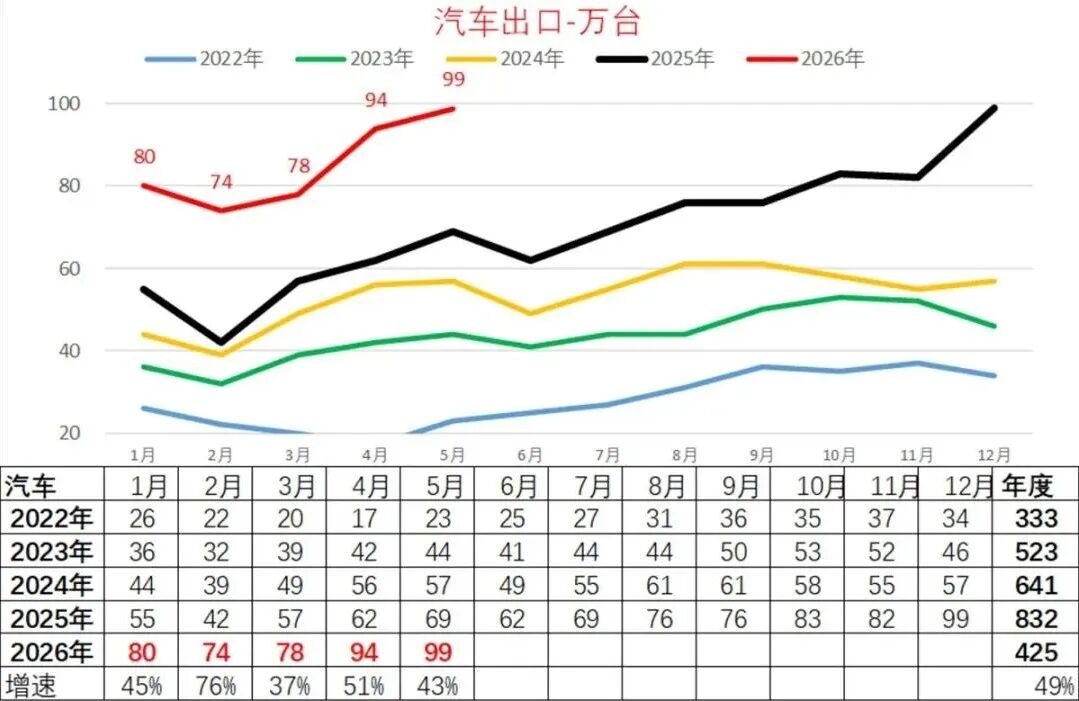
Picture: This picture is taken from a personal analysis article by Secretary-General Cui Dongshu of the Passenger Transport Association. It follows the concept of complete vehicle export in a broad sense, or includes KD partial parts conversion
Relying on strong production capacity, abundant orders and increasingly improved overseas channels, the industry predicts that China's automobile exports will approach 5 million units in the first half of this year, and the total annual export volume is expected to exceed 10 million units for the first time, setting a new benchmark in history. Cui Dongshu, secretary-general of the Chenglian Branch, is more optimistic. Combined with the cyclical pattern of the industry's production and sales volume in the second half of the year, China's automobile exports are expected to hit 12 million vehicles in 2026, opening a new era of going to sea.
This mighty wave of going to sea has injected majestic vitality into the domestic automobile industry, which is mired in the cold winter of domestic demand. In the first five months of this year, domestic sales of automobiles in China fell by 19.5% year-on-year. The bucking trend of overseas markets has hedged the downward pressure of the domestic cycle and stabilized the company's operating chassis.
However, under the prosperity, the dark tide is surging.
When the heavy artillery of goods made in China surged around the world, squeezing the living space of established European and American car companies step by step, the trade pattern that has not changed for a century suddenly loosened. A profound proposition of the times ensued-can the free trade order dominated by Europe and the United States in the past continue?
When the global "center-periphery" pattern is completely inverted, and the established industrial powers will inevitably break the rules, sacrifice barriers, and launch an all-round game counterattack in the face of emerging economies.
1. Exports can buy time, but they are not the real antidote to the problem
To understand the deep meaning of tens of millions of cars going out to sea, we must first clarify the essence of the industry: automobiles are cutting-edge terminal products with the longest industrial chain and the widest linkage field in the modern industrial system. The birth of a complete vehicle connects tens of thousands of parts and components, spanning many categories such as heavy industry, chemicals, electronics, and intelligent algorithms.
The absolute advantage of China's cars in riding overseas today stems from the deep cultivation of the entire industrial chain. From the intensive processing of lithium battery core minerals, to the independent iteration of battery materials and battery cell manufacturing, to the global new energy map built in the BYD and Ningde era, China's new energy vehicles have built an independently controllable entire industrial chain system. After being tempered by fierce competition in the domestic market, the production efficiency and cost control of the entire industrial chain have ranked among the top in the world.
In 2026, retail sales in the domestic automobile market will decline by nearly 20% year-on-year. Against this background, tens of millions of overseas exports have become a strategic buffer zone to support the domestic manufacturing chassis and a spillway for the entire industrial chain to relieve production capacity pressure. Without massive external demand, the financial risks in the industrial chain will spread and ferment, and millions of upstream and downstream jobs may be under chain pressure.
However, we must be soberly introspective. The current unbalanced pattern of "cold inside and hot outside" is breeding hidden development misunderstandings. At present, domestic residents 'consumer confidence is weak. On the premise that the shortcomings of domestic demand have not been eradicated, the industry's dependence on overseas markets continues to deepen, which can easily lead to the cognitive illusion that "external demand can sustainably offset weak domestic demand." It should be noted that every round of large-scale commodity going out to sea is a reconstruction and impact on the local industries of the importing country. The larger the scale of exports, the more conflicts and checks and balances between local industries around the world will increase.
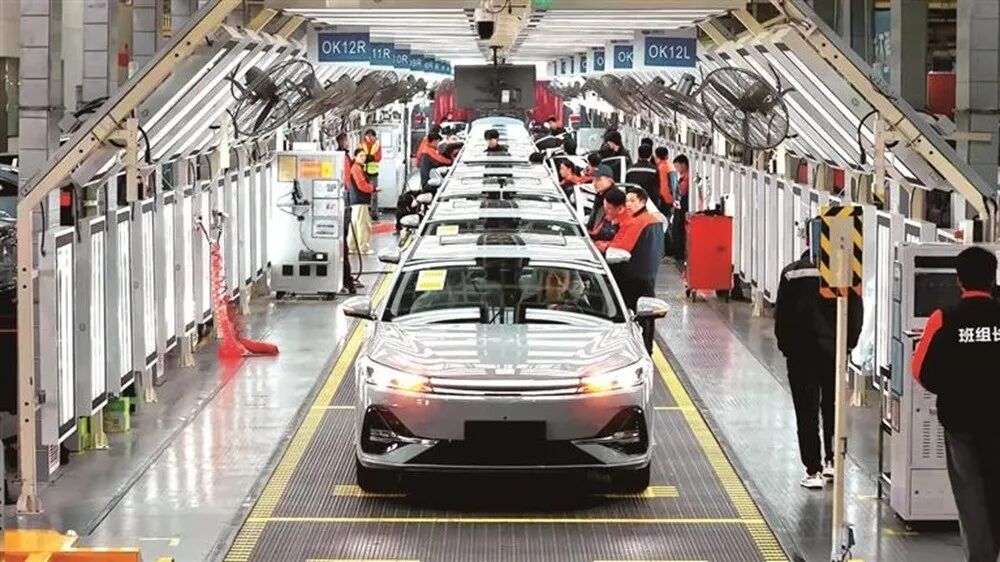
At the same time, the structural imbalance in the distribution of export dividends has become increasingly prominent. New energy industry highlands such as the Yangtze River Delta, Pearl River Delta, Chongqing, and Hefei enjoy the dividends of sailing; while old industrial chains such as heavy industry and casting in traditional fuel vehicle towns are gradually declining. The eye-catching GDP data created by tens of millions of exports conceals the deep crux of regional industrial differentiation and unbalanced industrial structure.
At a deeper level, various contradictions are intertwined: how to balance the distribution of export dividends between public and private capital? Has the increase in industrial concentration squeezed workers 'employment space and bargaining rights? Does the excessively tilted export orientation divert resources for cultivating domestic demand?
These intertwined structural contradictions are the core bottlenecks that hinder the long-term healthy development of the industry. Before this round of sea waves completely solves these deep-seated shortcomings, it is ultimately only a strategic window for domestic industrial transformation and domestic demand restoration, rather than the ultimate answer to sustainable development.
2. Be wary of the "weaponization of rules" in Europe and the United States
The export blueprint of tens of millions of vehicles is expected throughout the year, with a maximum of 12 million vehicles. In the current online public opinion field where "winning learning" is prevalent, there is a carnival narrative that is simplified to "complete victory for domestic products", but the real risks are being ignored. Accumulated rapidly.
As mentioned above, with its astonishing size, the automobile industry has never been a simple manufacturing industry, but a lifeblood industry related to the rise and fall of a region and a country. Therefore, when my country's automobile exports dominate the world, as the volume of trade crosses a critical point, pure commercial economy and trade no longer exist, and it will inevitably be upgraded to a rule game and strength confrontation at the national level.
The "free trade" that Europe and the United States have advertised for hundreds of years has never been a universal axiom. It is only a tool to reap benefits when they occupy industrial hegemony. When emerging economies shake their monopoly profits, Europe and the United States will immediately abandon free narratives, use "security" and "compliance" as excuses, and even use "human rights" and other issues to create cards out of thin air, and use state machinery to intervene in the market.
Based on existing experience, compared with conventional tariff barriers, Europe and the United States 'suppression of China's automobile industry is more subtle and thorough. Its essence is to package national coercive forces such as judicial sanctions, financial controls, and administrative intervention as "non-military institutional heavy artillery" to implement all-round containment of China cars going out to sea.
Tariffs and quotas are the most straightforward front barriers. The European Union implements stepped tariffs, while the United States isolates China's complete vehicles from the domestic market. Generalizing the concept of national security is the core means of precise strangulation in the United States. The United States deliberately amplifies the data attributes of intelligent connected vehicles and relies on administrative tools such as foreign investment review and entity lists to distort commercial competition into national security confrontation. Europe focuses on standards and carbon barriers and builds high compliance walls. A series of strict new regulations such as battery passports, full life cycle carbon emissions accounting, and supply chain due diligence have accurately benchmarked China's new energy upstream industrial chain and significantly increased compliance costs.
After the straightforward trade barriers, the undercurrent surging below the surface is the joint efforts of the United States and Europe to promote the dual decoupling of technology and finance and weave a global blockade network. The United States continues to expand the so-called entity list to suppress our companies and collude with so-called allies. Countries cut off the technical channels for China car companies to expand overseas production, and at the same time coerce transit markets such as Mexico, Turkey, and ASEAN to set up "China component thresholds" to eliminate re-export risks.
Looking at the complete set of suppression logic of various European and American forces, the core is to circumvent the WTO multilateral arbitration system, use "national security, climate justice" as the moral packaging, and unilaterally rewrite trade rules. This is the inevitable result of the deep binding of monopoly capital and the state apparatus: when market means are unable to curb the rise of China's industries, state coercion will come to the forefront.
It should be noted that the risks of going to sea are not only found in developed markets in Europe and the United States. Although emerging markets such as Southeast Asia and the Middle East are blue oceans for China's automobiles, most developing economies generally have problems such as weak governance systems and shortage of foreign exchange reserves. As China's automobile imports surge, such countries may introduce policies such as import bans, foreign exchange controls, and compulsory localized production at any time, posing sudden risks for automobile companies to go abroad.
In a word, the more powerful China's cars go to sea, the stronger they will be in reshaping the inherent global industrial pattern. The normalized, multi-level and global trade game has become the long-term background for China's cars to go abroad.
3. What is the real moat under the "muzzle"?
Marx's theory of heavy artillery on commodities explains the deep core of capitalist globalization-the market has never been a fair exchange in a vacuum, but a concrete extension of national strength and industrial voice. Looking at the historic leap of tens of millions of cars going out to sea, we should think dialectically and soberly. This breakthrough is a grand counterattack of modern China's industry; but we also need to face up to our shortcomings: at present, we only hold the sword of "commodity heavy artillery", while our opponents hold the "rule barriers" built by a complete set of state machinery.
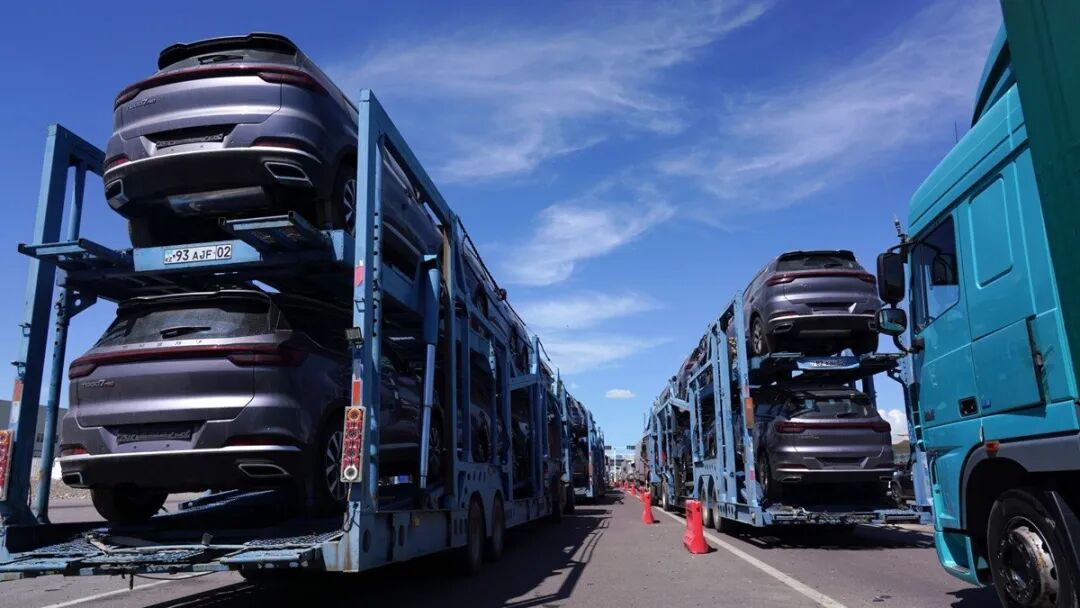
Tariff barriers are just outposts of the game. The real deep crisis is the compression implemented by all aspects of national forces such as technical standards, data security, and financial isolation after Europe and the United States defined China's automobile industry as a "systemic challenge." This means that in the second half of the voyage of China cars, a single cost-effective advantage will no longer support a long-term breakthrough.
The real industrial moat has never been a short-term peak sales, but a long-term ability to take root in the industry and overall game resilience. In the future, China car companies need to break out of the shallow logic of "low prices and volume", adapt to the interest patterns of different regions, and deeply embed themselves into the local economic fabric through production capacity implementation and supply chain localization, so as to eliminate the excuse of external containment.
Of course, enterprises based on the market and pragmatic cultivation are the foundation for maintaining results. However, it is difficult to withstand national-level systemic containment alone by relying solely on the individual breakthroughs of market entities. Heavy commodity artillery can break down market barriers. Only by taking root in symbiosis, adapting rules, and binding interests can the foundation of the market be maintained. The export volume of tens of millions is a rite of passage for China's manufacturing industry-it is the first time that we have stood at the core of the global game, not only breaking through with industry edge, but also facing containment with calm determination.
This mighty wave of going to sea has won us a valuable window to repair domestic demand and optimize the structure. We must not only use the penetrating power of heavy commodities to break through the industrial barriers that have been entrenched for a century, but also transform the breakthrough into industrial resilience that deeply cultivates the world. While enterprises are joining the market on the front line, they need the country to use institutional openness, international rule games and China's rule of law to build a solid security barrier for industries to go out to sea and form a two-way synergy of "enterprises charging and state escorting."
Marx once said: "Of course, the weapon of criticism cannot replace the weapon of criticism. Material power can only be destroyed by material power; but once theory is grasped by the masses, it will also become material power." Automobiles, as the most representative industrial material force in the contemporary era, will eventually carry the accumulation of China's manufacturing industry for half a century. In the wave of global games, they will complete the transformation from scale breakthrough to pattern victory.
Source: 36 krypton going to sea
[Disclaimer] The content of this website (including pictures and texts) originates from the Internet, and the copyright belongs to the original author. Respect the rights and interests of originality, and select content is only used for information sharing. If copyright disputes are involved, please contact us to handle them in a timely manner
Keywords: 36 Krypton going to sea·Industry| Impact 12 million exports! China's cars will face the test of adulthood
Related Information
Company News
-
Take advantage of the east wind of the "Belt and Road" and deeply explore the Cambodia automobile market| DG MOTORS Phnom Penh Store, Overseas Store in China (Chongqing Banan) Used Car Export Base, moves to a new location and opens grandly
Time:2026-03-24
-
Huanyu Automobile signed an agreement on the coordinated development of national used car export bases and joined hands with 7 major bases to expand new channels to sea.
Time:2026-06-12
-
Twenty-six years of hard work| Huanyu Automobile's 26th anniversary celebration and veteran employee commendation meeting were successfully held
Time:2026-06-08
-
Chongqing's 2026 second-hand car purchase subsidy policy will be officially implemented. Huanyu Automobile will be included in the officially designated declaration point
Time:2026-05-19
-
Implementation of new tariff policy in Cambodia| Consul General Wen Weiye visited China (Banan, Chongqing) used car export base to explore new opportunities for second-hand new energy vehicles going abroad
Time:2026-04-02
-
China (Chongqing·Banan) used car export base: Linking the world, quality and good cars go to the world
Time:2026-03-24
-
Fu Yi was invited to participate in the New Year Friendship Meeting of Foreign Consulate General in Chongqing and overseas business institutions in Chongqing
Time:2026-02-06
-
Chongqing RCEP Investment and Trade Service Center's Chongqing Car Overseas Business Unit was officially unveiled
Time:2025-12-31
-
The synergy of "platform+enterprise+service" empowers the Chongqing RCEP Service Center to add wings to the "Chongqing Car Going Global" initiative
Time:2025-12-30
-
Chongqing Banan Second hand Car Export Base signs contract with RCEP Service Center to jointly promote 'Chongqing cars going global'
Time:2025-12-29
-
China (Chongqing Banan) Second hand Car Export Base VR Reality officially launched
Time:2025-12-24
-
Chongqing Banan Second hand Car Export Base welcomes multi-party inspections to discuss the plan for Chongqing cars to go global
Time:2025-12-23
-
Vice Director Zhou Chengqing of Banan District People's Congress conducted research on Huanyu Automobile Company
Time:2024-12-27
-
Xu Jianghai, a member of the Standing Committee, visited Huanyu Automobile Company for research and discussed the development of a second-hand car export base
Time:2024-11-20
-
Huanyu Automobile joins hands with Eurasian partners to seek a new chapter in the export of new energy used cars
Time:2024-09-22
Industry Insights
-
Georgia's car imports fall to four years: U.S. cars account for the majority, and China ranks fifth
Time:2026-06-29
-
2026 is crazy! The export volume of many domestically produced cars has soared?
Time:2026-06-26
-
Russia's Far East car imports hit a record high: 22.8% in the first five months, with Japan still accounting for 90%
Time:2026-06-26
-
Brazil soared 226%, Mexico halved-what are China's auto exports going through
Time:2026-06-25
-
A complete prospect analysis of the export of pure and real used private cars (excluding zero-kilometer quasi-new cars, the main line of compliance in 2026)
Time:2026-06-25
-
Pakistan plans to liberalize the import of five-year-old used cars: a highly protected market may usher in a major turn
Time:2026-06-24
-
Saudi Arabia suspends the entry of vehicles from 29 car companies: Failure to submit 2026 supply plans as a key reason
Time:2026-06-23
-
Hot information on the used car industry| The total export volume is expected to exceed 10 million
Time:2026-06-22
-
Shipping charges from China to Algeria soar: Some car dealers suspend imports, and the market enters a wait-and-see period
Time:2026-06-18
-
Zero-tariff new energy quotas are in full swing: China has become Argentina's third largest source of cars
Time:2026-06-17
-
Uzbekistan liberalizes restrictions on individual car purchases: the era of only one car imported a year is over
Time:2026-06-16
-
Imported 1.9 million cars in two years: China has become a supplier to Saudi Arabia, and the market structure is reshaping
Time:2026-06-15
-
Egypt's electric vehicles begin to speed up: a cumulative import of more than 28,000 vehicles in five years, adding 1600 vehicles in a single month to a high level
Time:2026-06-11
-
9756 kilometers, 4809 vehicles: the full export link of cars in a ro-ro ship
Time:2026-06-10
-
Russia's new car imports doubled in May: China accounted for 73%, and the source pattern of used cars is also changing
Time:2026-06-09
-
Russia strikes again! The Eurasian Union's gray import channel for automobiles has been completely blocked, and new restrictions will be dynamically increased
Time:2026-06-08
-
Ukraine customs strike hard! Starting from June 8, half of the import of used cars will be subject to centralized strict inspection and will continue until the end of 2026
Time:2026-06-05
-
Starting from China! Changan Mazda's new direction
Time:2026-06-04
-
Entering South America, exporting new energy vehicles will lead to the next 100 billion track
Time:2026-06-04
-
Rereport depth| From "repeated inspections" to "full mutual recognition", Chongqing Maritime Innovation Supervision Services Help "Chongqing Vehicles Going to Sea" Reduce Costs and Speed Up
Time:2026-06-03
-
The top 10 countries in total real used car exports of China from January to May 2026
Time:2026-06-02
-
High oil prices once again shake the fundamentals of oil trucks, Kenya exempts the first 100,000 imported electric vehicles from tariffs
Time:2026-05-27
-
Nansha VS Horgos: Who is your ship?
Time:2026-05-26
-
The wind outlet has arrived! The used car markets of five South American countries ushered in a golden period
Time:2026-05-25
-
Russia's imports of used cars from China have surged 2.4 times in four months: Top ten imported models announced
Time:2026-05-21
-
Hailao Used Car Export Briefing·May 11, 2026
Time:2026-05-21
-
Growth rate of 35%! South America has become a new outlet for China's exports, and the profits of these five countries surpass Africa
Time:2026-05-20
-
Oil shortage drives Africa to shift to electrification, with Ethiopia accounting for 1/3 of China's exports of African tramcars
Time:2026-05-20
-
Heavy! Canada officially liberalizes the import of new energy vehicles from China. Is the North American market the next outlet?
Time:2026-05-20
-
New energy vehicles sail to Southeast Asia, and RCEP brings three major dividends
Time:2026-05-19
-
Want to bring your car into Mexico legally? First go through taxes, NOM and customs declaration agency
Time:2026-05-19
-
Kazakhstan issues new regulations: imposing punitive scrapping taxes on imported cars from Russia and Belarus
Time:2026-05-19
-
China and the United States establish a new positioning for "constructive strategic stable relationship"
Time:2026-05-15
-
China's used cars are popular in Algeria, but the lack of parts is a worry: intermediaries sell quickly, but maintenance cannot keep up
Time:2026-05-15
-
Chongqing Huanyu Automobile's senior management meets with representatives from Turkmenistan to jointly explore a new blueprint for second-hand car exports
Time:2024-12-05
-
The "Three Visits and Three Questions" Research Symposium of the Second Taxation Branch of Chongqing Taxation Bureau was held at the Huanyu Haoche 5S Store
Time:2024-10-18
Export Policy
-
36 Krypton going to sea·Industry| Impact 12 million exports! China's cars will face the test of adulthood
Time:2026-06-29
-
EU will impose tariffs on China cars again
Time:2026-06-24
-
Vehicle import costs surge in more than 6 years: Georgia's new regulations reshape the Caucasus car trade route
Time:2026-06-10
-
Received an order for 100 units! Nigeria becomes a new blue ocean for China's used car exports
Time:2026-06-09
-
What are second-hand exports waiting to be transferred? How to handle it? Need things?
Time:2026-06-05
-
[Russian New Regulations] SPOT cargo pre-confirmation system is officially implemented
Time:2026-06-04
-
Belarusians are crazy about "overseas shopping" used cars: individuals imported 38,000 vehicles, and SUVs became the protagonist
Time:2026-06-03
-
Heavy benefits: starting from July 1| Tariffs on used car exports to Nigeria drop sharply
Time:2026-06-02
-
Russia's "United Arab Emirates Low-Price Car" scam broke out: imported cars five times cheaper, but no car was seen later
Time:2026-06-01
-
What certification requirements are needed to export used cars to Africa?
Time:2026-05-29
-
From 4000 to 25000: The African electric vehicle market is starting to grow, and second-hand new energy exports are worthy of attention
Time:2026-05-29
-
With the implementation of the ceasefire in the Middle East, China's second-hand car exports have ushered in a phased explosion
Time:2026-05-29
-
Russia's "parallel import" craze 20 cars released: Mazda CX-5 tops, SUVs continue to dominate the market
Time:2026-05-28
-
How to Choose High-Quality Left-Hand Drive Used Cars for Export | A Complete Guide for Importers
Time:2026-05-27
-
Common Mistakes to Avoid When Importing Cars to Russia | 2026 Guide for Importers
Time:2026-05-26
-
Algeria urgently refutes rumors: New rules on used car imports have not been officially announced within 10 years of opening
Time:2026-05-26
-
Moldova's car market has exploded nearly fourfold in five years: Chinese-made vehicles account for 40% and electric vehicles account for 30%
Time:2026-05-25
-
Inventory of popular used car models in Ghana in 2026
Time:2026-05-22
-
Full interpretation of the 2026 new regulations on used car exports to Nigeria
Time:2026-05-22
-
Title: Top 5 Cost-Effective LHD SUVs for Nigeria Export 2026 | Zero-Tariff EV Options Included
Time:2026-05-22
-
Interpretation of the new regulations on used car exports from Ghana
Time:2026-05-21
-
Title: Senegal Used Car Import Rules 2026 | LHD Only, Age Limit & Certification Guide
Time:2026-05-21
Prev: Nothing!


Contact Us
Address.: 1-1, Longzhou Boulevard No. 2899, Banan District, Chongqing, China.
E-mail:hyu55002@gmail.com
Tel:+86 400-636-0012
Phone:+86 158 2345 6606
WhatsApp:+86 15823456606
Get In Touch
Ready to take the next step? We’d love to hear about your upcoming project.

Mobile Version

VR
Copyright © 2026 Chongqing Huanyu Automobile Sales Co., Ltd. All Rights Reserved. Powered by: www.300.cn
WhatsApp:8615823456606
Phone:+86 158 2345 6606
Tel:+86 400-636-0012
E-mail:hyu55002@gmail.com
Business Cards
Intelligent Customer Service